
The New Don of the Daily Duppy: An Interview with GRM Daily’s Editor-in-Chief

You may not have heard the name Alex Griffin, but if you’re into Grime music, then you should know about GRM Daily.

It is one of the leading websites in Grime and Hip-Hop in the UK, with over 1 million followers across all of its social media platforms. It is estimated to attract around 15,000 new followers per month on average.

GRM Daily achieves this by regularly featuring interviews with the biggest names in the genre, Big Narstie and Mike Skinner to name a couple.

It is also the home of videos like Daily Duppy– a misleadingly titled series of rap freestyles from top artists such as Stormzy, Giggs, and Scrufizzer.
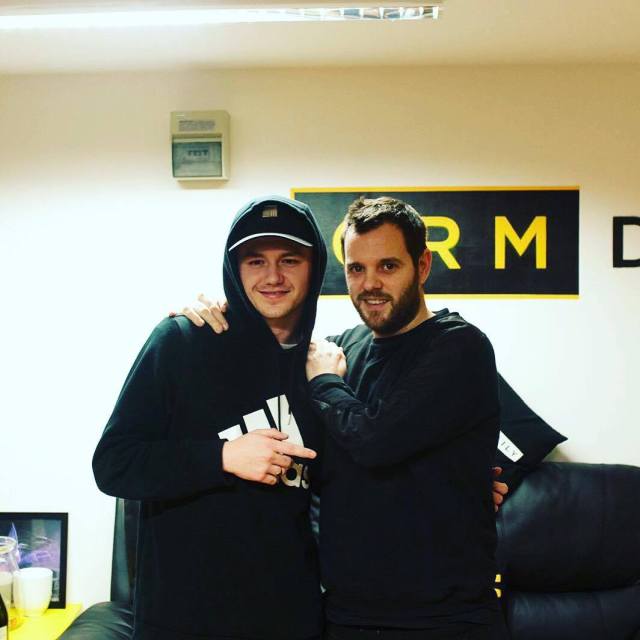
Alex and Saquib
Left – Alex Griffin

Bristol-born Alex Griffin recently became editor-in-chief of GRM Daily after having started as an unpaid contributor. In April last year, he was given his first paid role as a junior editor, before being promoted to co-editor.

“I just put myself in a position where they needed me,” Alex said, “and I applied myself to what they needed.

“Circumstance meant that the current editor was moving out into a different job, and they were trying to work out the best way to play it- so that’s why I was co-editor for a while.

“Eventually it got to the point where they were like, ‘you’re the only one doing that job, so you’re the editor’, and I was like, great.”

It wasn’t so long ago that Alex was cutting his teeth with a website called Mad Good Music, which expanded into a brand that ran music events in the South West.

Much like GRM Daily, Mad Good Music focussed reporting within the fields of Grime and Hip-Hop, whilst also promoting smaller local artists from around the university.

The website saw a degree of success, especially after a run-in with Example in its infancy:

“The first time I got proper views was when Example cussed me, because I cussed him in an article, saying he had a shit album, because it wasn’t a very good album. He didn’t like it.”

Alex had tweeted his article about the top-10 most disappointing albums in 2013, including an unfavourable write-up of The Evolution of Man, to Example. ‘Hey Example, your album made it onto our top-ten list of most disappointing albums this year’, the tweet read.

Alex remembered. “Yeah, and he said, ‘Well done, you’re on the top ten blogs nobody reads…’

“I mean, it was a fair assessment at the time.”

17204385_1623732604307963_1846615167_n

At Mad Good’s height in 2015, the website was pulling in up to 1,000 visitors per day. Today, the website is no longer online, as Alex has directed his energies towards his career in GRM Daily.

“I dunno,” Alex said, a little sadly. “I always said it was on hiatus and it’s something that I keep close to me, and I would love to pick it up again one day.

“Just being 100 per cent honest with you, it wasn’t making me money. I had too much work to do, it was like one step forwards and ten steps back.

“I felt like I needed to cement myself as a person in a career, before I could bring up a whole business with me… It was pulling me down a little bit.”

I was also downhearted to see Mad Good Music taken off the internet. I was there for its inception. Back in 2013, Alex and myself were living in a flat together, attending Falmouth University.

I remember very well when Example called Alex out, and ironically ignited Mad Good. I also remember the events that Mad Good Music used to run, including a musical variety night that took place in a hip hairdresser’s in the town centre.

Around that time, in no small part thanks to a strong and vibrant alternative music scene active in Cornwall, we used to party.

A lot.

But while as I struggled to keep a tankful of fish alive in between hangovers and deadlines, Alex managed to pro-actively maintain and cultivate an impressive media following for his website and his projects.

This will be the first year that GRM Daily will be under his steering, so I asked him what the future held for the brand:

“There is loads of stuff…I can’t give you too much details… but there’s loads to look out for, we’re going to be very present this year… it’s going to be a cold summer, boy!”

Alex also pointed me towards his new sub-brand on the website called Go Left. It goes back to his roots in many ways, seeking out and featuring alternative Grime, Hip-Hop and R&B acts and artists and giving them a platform.

“I’m going to be doing a couple radio show takeovers, so all that’s coming soon.”
17273868_1623732944307929_794661781_oI decided to finish on a question I usually reserve for political interviews.

Grime and Hip-Hop are in many ways a voice of protest from disenfranchised masses.

Recently, many people have cynically remarked how recent political upheaval (the rise of the alt-right, Brexit, Trump, etc.) will create a golden age for satirical journalists.

Could it also provide a stimulus for a new wave of politically conscious Grime and Hip-Hop?

“I don’t think [Brexit, Trump, etc. are] going to dramatically affect the content. Everyone’s not just going to go on a rager, they’re still going to make fun music and have a laugh.

“But- it would be stupid to think it’s not going to have an effect. Especially in America, with Trump, there’s going to be constant references and stuff.

“Over here? I guess… music always reflects what’s going on in society one way or another… Grime is compared to Punk Rock a lot these days, because it’s got a lot of the same drive behind it.

“MCs are bound to speak out about the referendum… that anti-establishment energy has always been there. This just gives people something to talk about.”

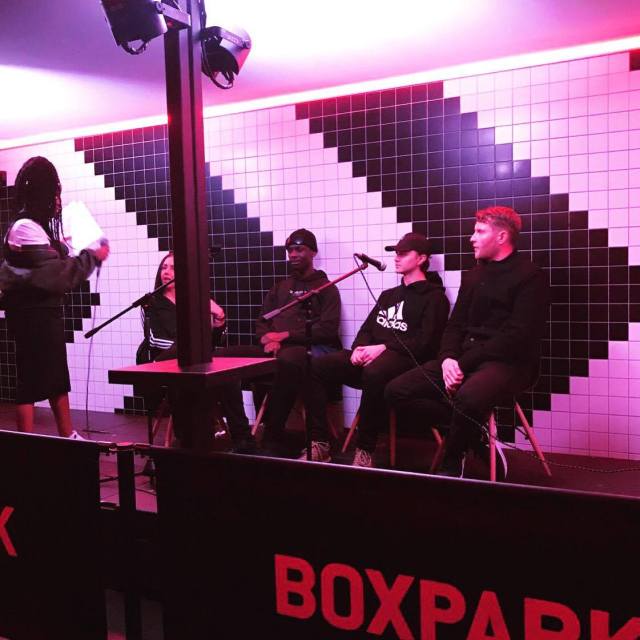
GRM Daily staff photo
GRM Daily

Images courtesy of Alex Griffin 
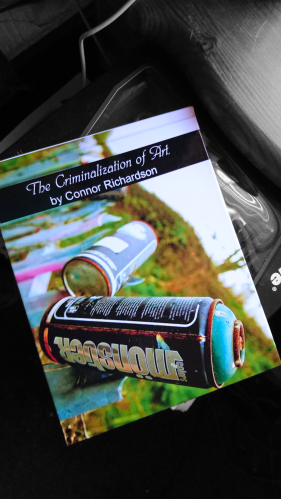
The Criminalization of Art

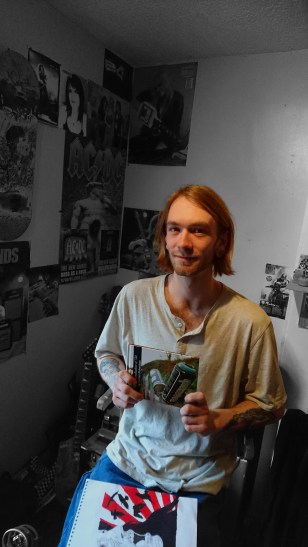
Nuneaton-based photographer Connor Richardson talks about art, decay, and the role of graffiti as a creative outlet.

connor_profile_book
Pictured: Connor Richardson

From the window, you can see the mouth of an industrial estate backing onto the estate. The houses directly outside are flat terraces with flaking walls. This is Nuneaton, a working-class town in Warwickshire that has fallen on hard times.

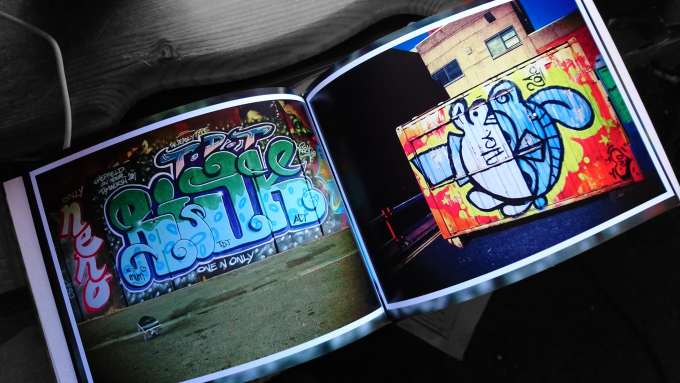
Connor has focussed his energies for his new photobook, The Criminalization of Art, on street art and graffiti in and around Nuneaton. From cover to cover, the book is filled with photos of crumbling walls made brighter with huge, garish designs.

Some of them are highly political- a swallow with a bomb for a head dives towards the ground in one – and others are more traditional ‘tags’, highly stylised personal brands and names in enormous colourful fonts.

In 2016, just under 20 per cent of households in Nuneaton and Bedworth were “workless”- with nobody in the household over the age of 16 in employment – compared to the country’s average of just over 15 per cent.

Nuneaton is the barely-beating heart of austerity Britain.

criminalisation_of_art_cover
The Criminalization of Art

I asked Connor how much being brought up in Nuneaton had influenced his decision to capture street art.


“A good quote that has always stuck with me,” he said, “which I find relevant to street art in this town, is Ernst Fischer: ‘In a decaying society, art, if it is truthful, must also reflect decay’

“Having come from this kind of town, [and recognised that] there is a lot of decay here… that has helped me realise the potential in terms of beauty behind such run-down kinds of scenes.”

Connor hasn’t always been a photographer- he started out drawing and painting, but segued into photography when he got bored of other mediums:

“I had been drawing for so long, I just needed another outlet, another way of expressing myself… with photography being completely different to traditional forms of art just… I took to it, really.”

The inspiration for his style is diverse. Connor cites both the gritty, documentary styles of Sally Mann and the surrealist and painting-like works of Ellen Rogers as influences

“[Ellen Rogers] uses a very interesting colour palette… she uses very old format cameras, which bring a very vintage feel to it. I’ve tried achieve this in some of them photos, by using some very lo-fi cameras, low end toy cameras, stuff like that.”

criminalisation_of_art_murals_v2
An example of some of the murals photographed for the book.

His work is in some ways a critical response to the teaching he received in photography from his days at Coventry University:


“Having gone college and university, you’re only ever really exposed to the more traditional forms of art: pretty paintings, pretty photos with pretty people in, and pretty landscapes.

“I’ve always had a disconnect from that. There was nothing I could really relate to. Having come from a town like this… I kind of found the beauty in the decay of it all.”

For Connor, it is important that art is truthful; especially concerning his photography. I asked him if he had done any of the street art featured in his photos himself:

“None of them- I wanted to portray other people’s work. I thought it would be a bit more truthful.

“One of the points I make in the book – and one of the main reasons I like street art – is that it’s done without any recognition, or any forms of profitable gains for the artist.

“It is an expression of their work that they are willing to put up for free, for anybody to view. It’s not like you’re putting out work for the sake of recognition.”

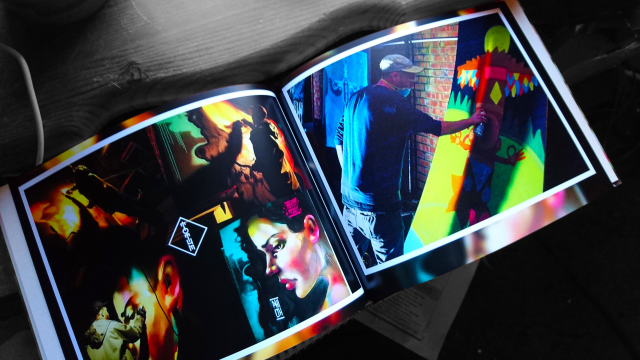
criminalisation_of_art_totum
Photos taken from a live street art demonstration at Totum, a Drum and Bass event held at The Railway Tavern, Nuneaton.

The truth in this is undeniable- if street artists owned up to their work, the police would have a field day. It’s easy to forget that the law considers all forms of graffiti and street art as vandalism, and that there are huge costs incurred to local councils in cleaning it up.


In 2007 The Chronicle, a daily newspaper from the North East, reported a £1.3m spend over the course of one year of trying to remove graffiti. In Newcastle, anti-graffiti squads were called up to 15 times a day.

“There are some buildings and some locations which I don’t believe should be used as a medium for street art,” Connor said.

“I understand the moral issues around it, but it is going to exist either way… I do think it is important to document them while they last.

“It’s a matter of enjoying it. That’s all street art is. A lot of people will walk past, see a mural, see a piece… and they’re just happy looking at it, walking past it.

“That’s what you need to do with the book as well. Enjoy it.”

You can purchase The Criminalization of Art by contacting Connor through his Facebook page: https://www.facebook.com/connorrichardsonarts/

criminalisation_of_art_inside_page
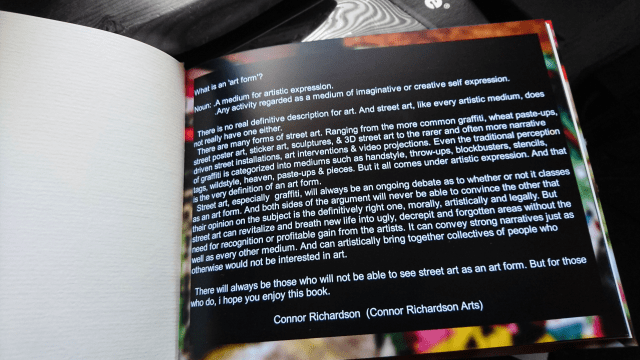
A discussion of graffiti as an art form, in the opening pages of the book.

Trump: A Family History

23690169609
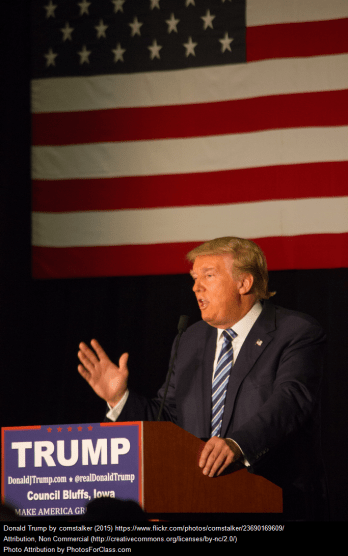
President Donald Trump

You are probably by now already hideously aware of The Great American Mistake.

Within a short space of time, President Donald Trump has made an executive order to reopen the Keystone Dakota oil pipeline, damning a large community of Native Americans to unsafe water supplies.

He has also banned people from “Muslim majority countries” entering the USA, in the name of ending terrorism. This has closed America’s doors to the tired, poor and huddled masses left without homes and without hope, trapped in chaos driven by war.

On the 17th January 2017, I interviewed the documentary filmmaker Paul Berczeller, who has made a documentary for Channel 4 about the origins of Donald Trump, going back to his grandfather who emigrated from Germany and ran brothels for gold miners in the Old West.

I talked to him about what had to happen to create a Donald Trump, and to get his perspective on the reality of a Trump presidency.

Paul’s film ‘Meet the Trumps’ is available to watch on All4 here.

This interview was initially recorded for iRadio Coventry, and aired on 17/01/2017. 

The Fall and Rise of CallumBOOM! and Wobi Tide

callumdark

An interview with the infamous Don’t Flop battle-rapper, and about his return to the scene

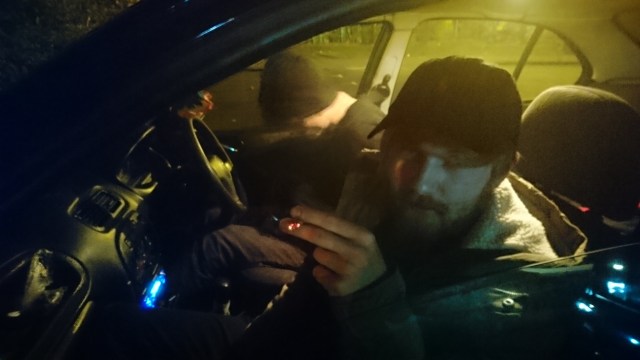
We were in a beaten-up old Rover – the front passenger-side door didn’t open from the inside – parked up next to a KFC on the outskirts of Nuneaton. It was 8pm, and outside was dark and cold.

Until very recently, Callum Clark has lost every battle he has been in. His two-vs-two battle with Chris Leese and Unanymous has been included on a YouTube playlist called ‘Don’t Flop Bodybags’, due to the severity of the put downs he received.

“A lot of people before the battle were like, ‘what you gonna be like’, because Unanymous and Chris Leese are known to get in people’s faces in battles” Callum says, “but it’s one of them where you know nothing’s gonna happen… you see me in the video, I laugh, I’m bobbing along to it, it doesn’t bother me at all.

“It’s like acting, or performing- all I can do is perform back.”

Don’t Flop is a popular battle-rapping competition which is broadcast over YouTube. Battle-rapping, for those not in the know, is a particular kind of a capella improvised rapping. The goal is essentially to berate your opponent into submission, using clever put-downs and high-class lyrical delivery.

To ‘flop’ is to be unable to deliver your next verse without hesitation.

Callum, more commonly known to fans of the battle-rap circuits as CallumBOOM!, has been pitted against some of the biggest names in the scene.

I met up with Callum to find out more about Don’t Flop, and to ask about his reinventing himself as Wobi Tide after a long hiatus.

As I was getting the levels corrected on my equipment, Callum Clark was rolling a joint and talking about his love of comic writers Alan Moore and Neil Gaiman, and also for the late fantasy author Terry Pratchett, renowned for his gentle wit and grasp of absurdity.

I decided to start from the beginning, and ask how it all began. Callum was brought up in Camp Hill – a notoriously deprived area in the north of Nuneaton.

“I could tell you one story of it where it sounds like a quaint little place, and you could look at it from a different point of view and say it was a rough area.

“I went out to swim in lakes, and fuckin’ build rope swings and stuff like that, which sounds like it’s out of a fuckin’ lovely little story… but also people have been killed there, and countless- mopeds, get stolen. That’s the perfect way to explain Camp Hill, stolen mopeds.

“But I enjoyed growing up in Camp Hill, I think it’s an interesting place, definitely.”

screen-grimecc
CallumBOOM! on an old GrimeCC cypher. Picture- GrimeCC, YouTube

Callum started out back in 2009 in Nuneaton crew Unknown Outfit- ironically, they were far better known by their YouTube channel name, GrimeCC.

I asked him where the rest of the crew are now.

“Splinta,” – Callum pauses – “that’s one of my oldest mates, best mate of mine called Ricky. He’s getting on with family life now, still writing… when I first started writing it was me and Ricky, when I first started rapping, me and Ricky.

“He weren’t a rapper, but behind the scenes… Matty Chinn, he went on doing some filming for the Paedophile Hunter [Stinson Hunter].”

Callum entered his first Don’t Flop battle rap competition in 2012, against then-

screen-impact
Don’t Flop battle against Impact. Picture- Don’t Flop, YouTube

newcomer Impact – “Big up Impact, he’s gone on to do good, big up Impact”.

Impact quickly took to the offensive and delivered some brutal bars.

“When it comes to raps, mine are like lightning strikes and thunder claps, entire galaxies are rent asunder when my lungs contract, you’ve awoke Cthulhu from his slumber, twat!”

CallumBOOM!, for want of a better word, ‘flopped’.

“Impact, you’ve never wrote a quick rap – you sound too si- ah, fuck.”

He accepts this post-mortem entirely- “Oh, I completely fucked up, 110%… I really didn’t take it as seriously as it was, I didn’t realise what Don’t Flop was, I didn’t understand how to write for an a capella rap battle… it is very, very different to writing stuff on beat.”

“My first round, the one where I fucked up the most, I wrote on the way to the battle… as I said, I just didn’t take the battle seriously, not in an ‘Ah, I think I’m amazing, dickhead’ kind of way, just… just that I was kind of a fucking idiot…

“After that, I got smoked, and that’s when I was like, right, I’ve got to do another battle now, to prove myself. I can’t let that be my last one.”

He then went on to do a few battles on rival YouTube channel RedJSD (due to a “lack of a call” for him to come back on Don’t Flop). One was against rapper Rogue– he maintains that “Out of all the battles I’ve done, I fuckin’ won that battle” – although almost immediately afterwards, he remands himself.

“I didn’t though, did I. They [the judges] voted against me, so I’m incorrect to say I won.”

In 2013, CallumBOOM! made his return to Don’t Flop. He teamed up with Two Can, first to go against rappers Pedro and Bamalam, before he had his most infamous battle against battle-rapping heavyweights Unanymous and Chris Leese.

screen-unan
Unanymous getting up close and personal. Picture – Don’t Flop, YouTube

Both Unanymous and Chris Leese later went on to individually contest Don’t Flop champion Tony D in a title battle, to become the champion of Don’t Flop. Callum described the battle with Tony D and Chris Leese as a “close one… some say that Chris Leese possibly beat Tony D then, but the judges went the other way.

“I really did go against two of the top people in Don’t Flop at the time, to see their quality of writing against mine, I was kind of put off looking at theirs and thinking ‘Jesus Christ, that’s quality’, and mine’s just a bit…” Callum blew a raspberry.

In battle rapping, very little is off-limits in terms of content. In CallumBOOM! and Two Can vs Unanymous and Chris Leese, the following lyric set, barked in tandem by the two competitors, demonstrated this rule completely:

Unanymous: “You’re looking a little stressed Callum…

Chris Leese: “We got a call from your ex, Callum…

Unanymous: “We found out you got placed under arrest Callum….

Chris Leese: “Because of the innocent little girl who wouldn’t give you any SEX, Callum!”

When I asked Callum about this, he said “That, is a good angle, you know? And they presented it well. It’s not true, at all, but… with the momentum they had… it was real good, they were a real good team together.”

He told me about how the bar originated from a real situation, in which a girl who was “a bit crazy for me”, accused him of “oral rape”. He was taken in for questioning, and the police swabbed his room for evidence. Nothing was found and the case was thrown out.

“It’s just crazy to me… nothing, nothing happened at all, and it all got proved that nothing happened, and it’s one of them sort of- maybe something should have happened to her for accusing me, because that’s a bit fucked up.

“Someone from round here who heard that, they were a big fan of Unanymous [told them]. So they said ‘You got arrested for raping this little girl’, when this girl who said this was older than me. Do you know what I mean?

But you know, it was a good angle, it was performed well, and fair-play.”

After this battle, CallumBOOM! might as well have walked into the sea- he released no new tracks, no new battles, nothing. In fact, CallumBOOM! wouldn’t ever appear again.

On the 19th October 2015, exactly one year prior to this interview, Callum Clark returned under the new name of Wobi Tide (after something his teachers used to say, “Woe betide the boy who stays out late”), with his new track Cedar.

“I hadn’t wrote for 3 years, just cause… I dunno, life was just a bit fuckin’ hectic, and even though people draw from things like that, I just didn’t have motivation at all, I was just a bit like… fuckin’, what’s the point, kind of thing.

“And then, I just, I dunno, got inspired again one time… I was just like yeah, I want to do it again, sort of thing.

“It [Cedar] was bars I’d previously wrote on a different beat, but didn’t record, so I was just like ‘Oh I’ll do it on this beat’… I found another beat, and it just gave it another push for me.”

I asked Callum what the future was for Wobi Tide and about his most recent battle, which was released on Don’t Flop’s channel on the 26 October.

“I’m currently writing at the minute, it’s just building a buzz at the minute, I might release a track every now and then but before I release a mixtape or anything like that… I want to release something that a fair few people will actually get and listen to.

“[For now] I’m just going to be doing freestyles, battles… I’d like to be a big battler, obviously, to not want to be number one would be stupid, obviously I’m not fuckin’ nowhere near any of that, but I’d like to do that… but I’d like to do music as well.”

Concerning his next Don’t Flop appearance:

“[I have now] won my first battle, before this, I’ve only won half a round [laughs].

“On my fuckin’ try-out bruv, geezer called Pete Cashmore – big up him, he’s someone who’s always reached out and been lovely, sound geezer he is- he fuckin’ gave me half a round on my first battle, and that’s the only vote I’ve had before.

“But yeah, I won this battle, 2-1 I think, one guy didn’t vote for me. Fuckin’ idiot [laughs]”.

callumlight

Additional: This is the first non-health related item on this blog. As mentioned in the previous post, I am going to start broadening my scope with this blog’s content, in order to accommodate and promote some of the other journalism that I do.

Cut For Stone’s focus will still be primarily on health. Consider this an experimental phase, to see what works. Please let me know what you think, and leave comments below.

Imprisonment, Isolation and Mental Health: An Interview with Dave Ginnelly

dg_bw
Dave Ginnelly

The mental health of prisoners in the United Kingdom has historically been overlooked. In this interview with true crime author and formerly regular inmate Dave Ginnelly, I attempt to get a clearer idea of what it was like to be imprisoned and placed into segregated units while coping with a mental health issue like depression.

If you haven’t had the opportunity, I do recommend that you give Dave’s books a read. His first book, Wellies and Warders, made it to the top of the Amazon charts for true-crime fiction on its release. He has now also released a sequel called Never a Dull Moment, in which he looks back at his childhood in much greater detail.

Both are available here:
https://www.amazon.co.uk/Wellies-Warders-My-Personal-Journey/

This is a part of a larger project I am working on, looking into the relationship between the criminal justice system and mental health.

Additional: I am just as aware as anyone that this blog hasn’t been updated in a while, for which I do apologise. I have been somewhat distracted this past year, and haven’t been able to give this blog the full attention it has needed.

In the interests of complete transparency, I have also in that space of time started to work for Coventry & Warwickshire Partnership NHS Trust. They are primarily a mental health Trust operating around Coventry & Warwickshire (funnily enough), and over the past year I have worked for both their Staff Engagement and Communications and Marketing teams. I now only work two days a week with Staff Engagement.

I have also recently begun my MA degree in Global Journalism at Coventry University. Originally, I was supposed to be doing Health Journalism, but due to the university’s management decision to cancel the course a few weeks before I started, I made the decision to swap course rather than go through the absolute nightmare of cancelling my student loan.

In future, I plan to use this blog as a space for my articles produced as part of this course. This will still be mostly health-oriented, but due to certain current conflicts of interest (see above), I will be extending the scope to include other work that I am doing as well.

Thanks very much for reading.

Jeremy Hunt is delusional- his response to the junior doctor strike action ballot proves it

Junior doctors have just voted overwhelmingly in support of strike action in response to the new Department of Health contract.  98% have advocated for proper strike action, and 99% have said they would support everything up to it. And yet, in an interview with BBC News, Jeremy Hunt still places the blame firmly on a militant BMA being unwilling to negotiate over terms:

This is the result of a very regrettable  campaign of misinformation by the BMA over the Summer that’s tried to scare doctors about these proposals, suggesting that they’re going to have big pay cuts. I would urge every doctor before they participate in this strike to actually look at the government’s offer: we are bringing down weekend rates in order to improve cover at weekends, but we’re increasing basic pay by around 11%.

Source: BBC News

In a web worthy of the most hardened conspiracy theorist, the Right Honourable MP has positioned himself as the spider, trying to hold the strands together against the onslaught of brainwashed BMA flies flying towards it. “Don’t worry, I won’t suck the life out of the health service,” he seems to say, “I won’t be cutting your pay, I will just be readjusting how it is delivered into a format that I find preferable. Oh, the professionals don’t agree? They’ve found that none of what I am saying adds up? They must be out to get me.”

Jeremy Hunt has also rejected any notion of conciliatory talks through the Advisory, Conciliation and Arbitration Service (ACAS),  saying that his ‘door has been open for talks since June, and the BMA have refused to engage at any stage with talks’. He tweeted recently that any pre-conditions that the BMA are referring to are completely fabricated, even having the gall to post a link to the letters to the Junior Doctor’s Committee (JDC) Chair in which the preconditions are described.

Back on the 4th November, the JDC Chair Dr Johann Malawana released a statement saying that:

To get back around the negotiating table we have repeatedly called on the government to remove the threat of imposition and provide us with concrete assurances on a safe and fair contract. Today’s announcement falls short on both counts as, once again, the headlines do not match up to reality.

Crucially, the proposals fail to deliver safeguards with real teeth to protect safe working patterns and, with it, patient and doctor safety. Furthermore, the proposals on pay, not for the first time, appear to be misleading. The increase in basic pay would be offset by changes to pay for unsocial hours – devaluing the vital work junior doctors do at evenings and weekends. While, in the short-term, existing junior doctors may have their pay protected, protections will only exist for a limited time.

Source: BMA

So, the JDC was willing to negotiate.

So, there were preconditions to the contract negotiations, including an imposition of the terms regarding pay, which I might again emphasise are laid out in the letters Mr Hunt posted online.

So, despite Mr Hunt’s insistences, there would be substantial effects on doctor’s pay.

So, it’s not all about pay in the first place, there are genuine concerns about the risks placed on patient safety by the new contract.

And he wonders why doctors have exactly zero trust in him?

hunt_2329078b
Clueless. Source: Geofff Pugh (The Telegraph)

I would prefer to give him the benefit of the doubt on this one. All of the evidence points towards a campaign of misinformation, not on the part of the JDC, but rather orchestrated by Jeremy Hunt and the Department of Health. This would all seem to indicate he is being wilfully dishonest; however, I suggest another option.

He genuinely believes everything he is saying, and he genuinely believes that the backlash given to him at every turn over his policies from people in the know is simply because he is poor old Jeremy Hunt, just trying to make the world better. In simpler terms, he is delusional, to the point where it is interfering with his job. He is caught up in the collective Tory delusion that by implementing private sector business practice everywhere, the country can be saved- even when it is demonstrably not working, it is just an element of militant doctors or left-wing malcontents trying to stir up trouble.

I prefer to believe this, because I’d rather he was delusional and incompetent, a man with fingers in his ears, than  to think for a second any of this was done intentionally. Either way, it is completely and utterly apparent that he is not fit for office- just remember that the petition to call a a vote of no confidence in Mr Hunt has, at current, over 225,000 signatures, more than twice the 100,000 for a debate to be held (which consisted of debating the ‘underlying issue in the petition which was started’, i.e. the contract conditions of NHS staff).

In response to Jeremy Hunt rejecting talks through ACAS, the BMA have released the following statement:

It is clear that trust has broken down between junior doctors and the government, which is why we are offering conciliatory talks via ACAS. If it is true that Jeremy Hunt has refused our offer, all he is doing is entrenching himself even further.

This is not just one or two junior doctors who believe that his proposals are unsafe for patients and unfair for doctors. The fact that today’s ballot result is near unanimous should be a wake-up call for the government. Instead of continuing to ignore the views of tens of thousands of junior doctors who, in the health secretary’s own words, are the backbone of the NHS, he should, if he really wants to avoid industrial action, accept the BMA’s offer of conciliatory talks.

Source: BMA

One can only hope that even the upper echelons of the Tory party must eventually take note of the catastrophic failures in the Department of Health, and reshuffle accordingly.

But it’s entirely possible that they are all delusional too.

UK Government’s regulations put GP practices at risk from health tourism

The BMA has issued new guidance to GPs requiring them to provide free consultations and routine care to non-UK residents, including tourists. This comes at a time when six out of ten GPs are considering retirement due to ‘workload pressures’, and a third are ‘actively planning for this decision’, according to a BMA press briefing from July 2014.

The BMA claims that the guidance has ‘remained the same as previously’ but ‘it has been re-worded and re-formatted for clarity.’ PULSE have also quoted a spokesperson as saying that entitlement to healthcare for non-UK residents has ‘long been an area of confusion for GPs, largely due to the absence of clear guidance from the [Department of Health] and NHS England’.

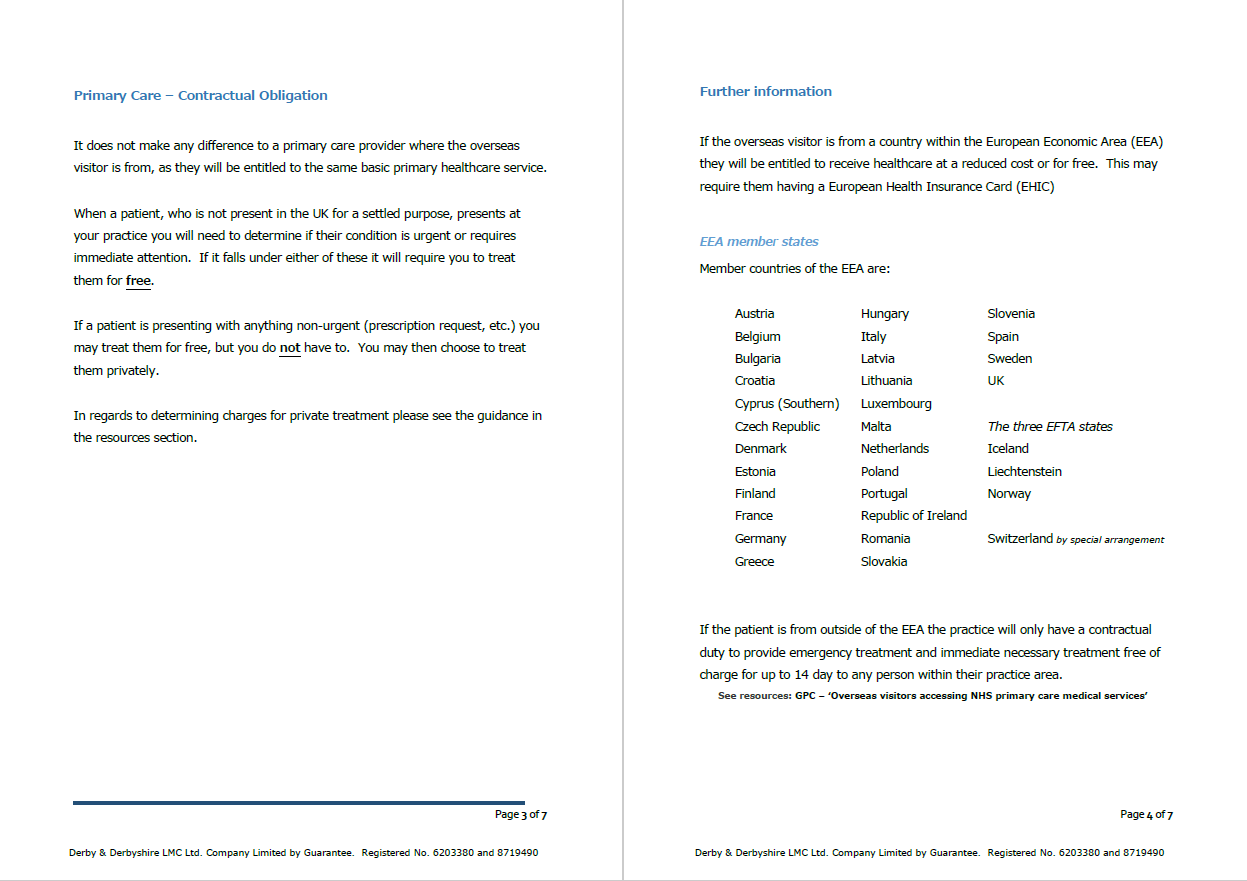
Derby & Derbyshire LMC guidance from August 2014 on charging overseas visitors, demonstrating how much the re-interpretation from the BMA has affected the practicalities of providing care for non-UK residents. Source: Derby & Derbyshire LMC
Derby & Derbyshire LMC guidance from August 2014 on charging overseas visitors, demonstrating how much the re-interpretation from the BMA has affected the practicalities of providing care for non-UK residents. Source: Derby & Derbyshire LMC 

Up until now, the general consensus among GPs seems to have been that it was up to the discretion of the practice to decide whether or not to charge for treatment of anything non-urgent to overseas visitors. A Derby & Derbyshire LMC guidance pamphlet on ‘Overseas Visitors’ from August 2014 also makes clear that any patient from outside of the EEA (European Economic Area) was only entitled to emergency treatment and immediate necessary treatment free of charge for up to 14 days. Under the new guidance however, anyone, ‘regardless of nationality and residential status may register and consult with a GP without charge’. 

The rewording of the guidelines has, despite the BMA’s assurances, completely changed their practical effect. One of the most worrying potential effects is to increase health tourism to the UK. This could potentially lead to yet another drain on the NHS’s dwindling financial resources, as people from outside of the EEA will effectively be paying nothing in the way of taxes or health insurance for the services provided. There are already procedures in effect to make sure that anyone in urgent need of healthcare, regardless of where they are from, will be able to get it through the NHS.

The Department of Health have taken something of a Schrödinger’s Cat approach to this. In April this year they launched a scheme in which patients without an EHIC (European Health Insurance Card) will be charged 150% of tariff pricing for secondary care in an effort to combat health tourism and retrieve £500m per year by 2017.

In response to this particular issue however, they have said that ‘international visitors are welcome to use the NHS provided they pay for it- just as families in the UK do through their taxes’, while also saying that they have a ‘long standing commitment not to charge patients directly for GP or nurse consultations’. The reason being, according to a Department of Health spokesperson, that keeping these services free is in the public interest as someone with a serious infectious illness like TB or Ebola might be ‘deterred from seeking treatment because they fear being charged’.

One can’t help but think that if a patient had Ebola (a horrific disease infamous for its tendency to cause bleeding from every orifice) that it would classify as emergency care requiring urgent treatment, and the patient probably wouldn’t be thinking of calmly booking an appointment with their GP, nor would they be tremendously worried about any sort of ‘charges’.

It should be noted that there are procedures in place to protect the vulnerable in the UK; asylum seekers and refugees are already entitled to treatment. Another overseas visitors guidance document produced by the GPC from May 2005 said that in the event that a patient is not eligible for free treatment and is unable to pay privately, they should be referred to The Refugee Council for assistance. It also notes a resolution passed at the LMC conference in 2004 ‘which opposed proposals to deny failed asylum seekers free primary medical services’.

It seems somewhat apparent, then, that all the bases for vulnerable non-UK and -EU residents seeking NHS treatment were already covered. This makes the new reinterpretations of the guidelines all the more perplexing.

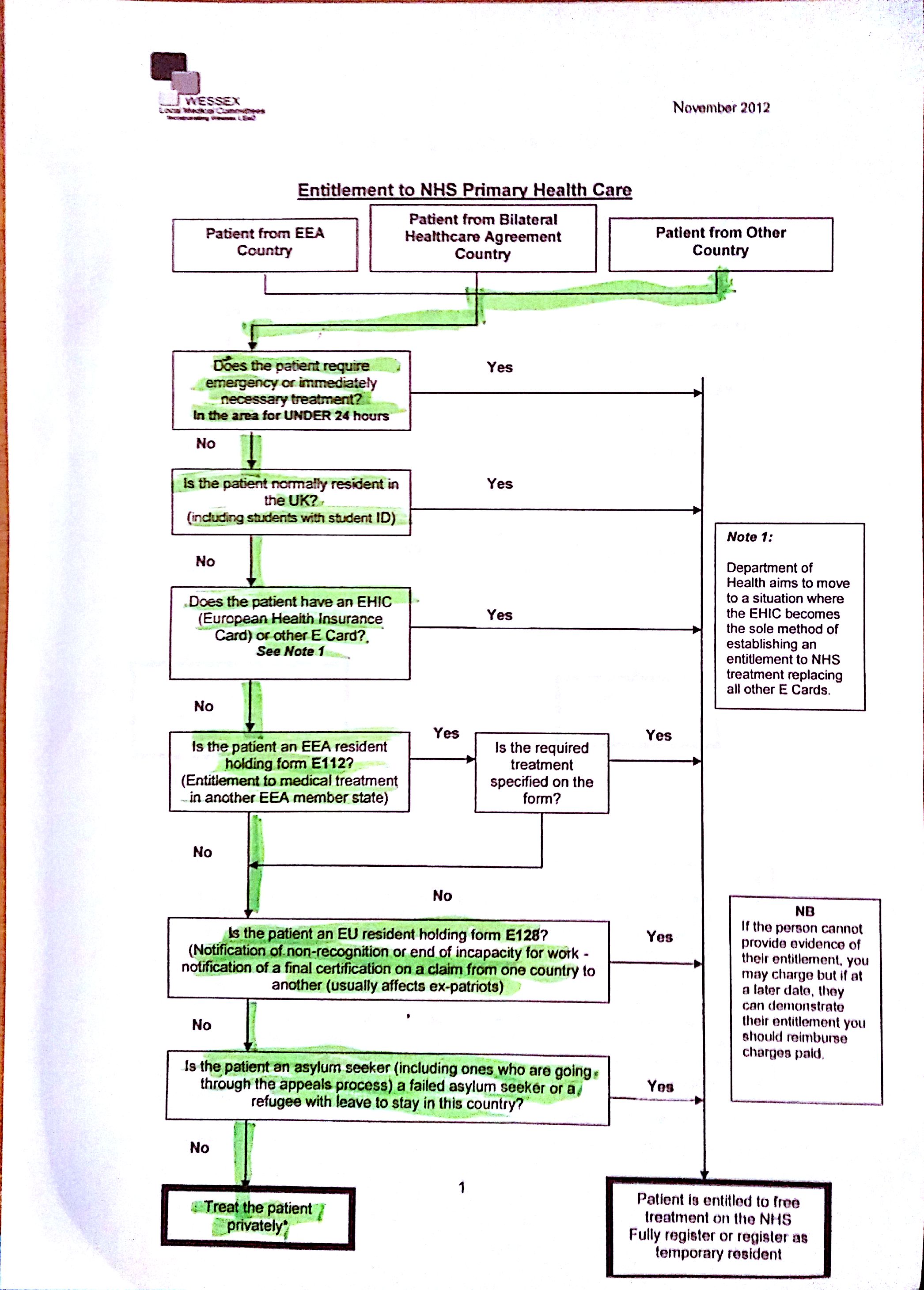
A flowchart distributed by Wessex LMC in November 2012 indicates that previously, primary care would be delivered privately, unless the patient was 'residing in the country for 3 months or more for a settled purpose'. Source: Wessex LMC
A flowchart distributed by Wessex LMC in November 2012 indicates that previously, primary care for non-UK residents outside of a particular set of circumstances would be delivered privately, unless the patient was ‘residing in the country for 3 months or more for a settled purpose’. Source: Wessex LMC

Already, the waiting times to see a GP have risen to 10 days, and are expected to rise to two weeks by next year. GP practices are facing a severe recruitment crisis, leaving GPs overworked and overstressed. Encouraging health tourists with the lure of free consultations will hardly help the matter; it doesn’t take a genius to figure out that a stressed doctor trying to get through a mountain of work is more likely to make mistakes which would be more costly to the general public than some nebulous fear peddled by the Department of Health about “Trojan horse” non-UK residents.

The NHS is not a charity. It is a taxpayer-funded health service. The money to treat patients doesn’t condense from the air like droplets in a glass bottle; it has to be trickled in from the general public and (theoretically at least) responsibly distributed to where it is needed. EEA residents also fund our NHS when they need treatment, through medical insurance cards and their own taxpayer’s money. In addition to this,  a survey conducted by PULSE shows that 77% of GPs support the government’s efforts to stop health tourism by charging foreign visitors for accessing primary care.

These new guidelines leave the NHS wide open to exploitation from health tourists seeking a cheap diagnosis and course of treatment. Dr Zishyan Syed, a GP in Kent, has said:

It is a sad reality but there is abuse of the NHS by foreign visitors. It is only fair that they pay upfront if they are not entitled to free care on the NHS. The NHS is in trouble and it is only right that the Government stops anyone from taking advantage of a system that is already under immense pressure.

Source: PULSE

It would be wonderful if the NHS could treat everyone in the world for free, but the realpolitik of the situation is that they cannot afford to. At this time, it is somewhat reckless for the BMA to reinterpret the guidelines in this way; although they are just following Government regulation. It is more damning that this has been done in the name of the Department of Health

Amendments: Title and other elements have been amended to more accurately reflect the story.

NHS England have since made contact. Their spokesperson has said:

There’s various things going on that have perhaps caused a bit of confusion. DH are looking into guidance around charging people from abroad.

All that we’re doing is just reconfirming the existing guidance around registration for patients. There has been a bit of confusion in some practices about asking for documents to prove that they were local or ordinarily resident, which isn’t required for primary care.

So we’re just reiterating new guidance, there’s nothing new in there.

There is a lot of confusion with word also going around that DH is considering charging for secondary or hospital treatment.

Source: NHS England

There is to be a Department of Health consultation regarding charging overseas visitors later this year. 

Why are young working class pupils’ medical aspirations being strangled in the cradle?

The BMA has issued a warning that students from deprived areas in the country may be ‘held back from a career in medicine’, because most medical schools require a GCSE in Triple Science in order to apply. This award was found not to be offered as often in deprived areas, and when it is offered, lower numbers of students applied for it. The BMA have called for all secondary schools to offer Triple Science as a course, for medical schools to consider contextual data (like details about the applicant’s school or where they live) in their admissions, and also for outreach schemes between medical schools and secondary schools to spot possible talent early on.

The Beveridge Report was published in 1942, and laid the basis of the push for adequate social welfare and greater social mobility in post-war Britain. It proposed support 'from cradle to grave'. Source: Wikipedia
The Beveridge Report was published in 1942, and laid the basis of the push for  social welfare and greater social mobility in post-war Britain. It proposed support ‘from cradle to grave’. Source: Wikipedia

I must admit, I don’t remember my own Triple Science classes being that under-subscribed. I went to school  in the Warwickshire town of Nuneaton. Nine areas in Nuneaton are featured in the 10% most deprived communities in the country, according to a report from Warwickshire Observatory from 24th March, 2015. For clarification, I don’t live in any of those nine areas, and I would not refer to myself as deprived by any stretch; however many of the people from my school came from these areas. Students at Higham Lane School (which I attended 2005-2010) were- and still are, as far as I know- offered the chance to do the Triple Science GCSE. Several people I know from school have gone on to medical schools and are currently in training to be doctors, although I would estimate that most of these people did come from middle-class households.

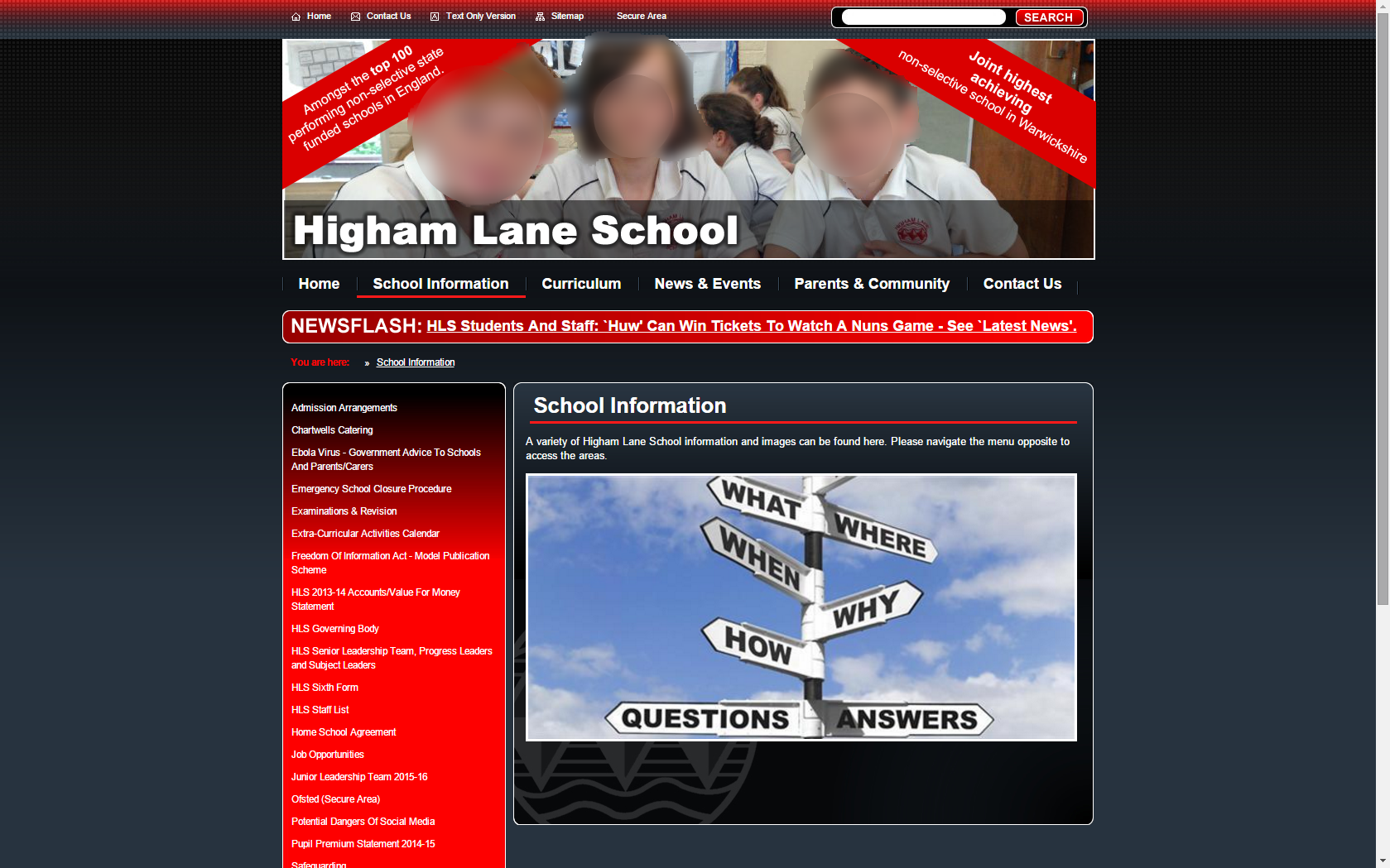
Higham Lane School's website says that they are amongst the top 100 performing non-selective state schools in the UK. Source: Higham Lane School
Higham Lane School’s website says that they are amongst the top 100 performing non-selective state schools in the UK. Source: Higham Lane School

That disclaimer aside, it is important to remember that one anecdotal case does not a rule make. The BMA’s report, ‘The Right Mix: how the medical profession is diversifying its workforce’, found that in the areas of Hull and Newcastle, less than 65% of schools offer the Triple Science course. In Newcastle, only around one in five students were taking the course (18%); in Hull, this was significantly lower, at around one in ten (11.4%). Compare this to Rutland, an area significantly more well-off than those mentioned, in which over a third of students (36.2%) study the subject, which is taught at all schools in the area. 80% of applicants to medical qualifications in the UK come from 20% of the schools, so one must cross their fingers and hope that the next Sir Alexander Fleming hasn’t had the misfortune to be born in Hull (sorry, Hull).

A possible problem is the perception of medical schools by people of lower socioeconomic class. A 2004 study published in the BMJ and co-authored by Professor Trisha Greenhalgh found that opinions of medical school didn’t change much when considered by gender (over half of medical students in 2013 were female) or by ethnicity. Class on the other hand had a significant effect:

Pupils from lower socioeconomic groups held stereotyped and superficial perceptions of doctors, saw medical school as culturally alien and geared towards “posh” students, and greatly underestimated their own chances of gaining a place and staying the course. […] Pupils from affluent backgrounds saw medicine as one of a menu of challenging career options with intrinsic rewards[.]

Source: PubMed Central

The study also found that while both groups were concerned about the costs of study, only the poorer pupils saw it as a factor of constraint.

There is a clear and obvious problem in the country today with the perception of the medical profession. With the current crises of under-staffing in hospitals across the country, it is also a potential time-bomb for the NHS. The recent furore over junior doctors and their salary cuts, along with Jeremy Hunt’s push for an ill-planned 24/7 NHS (as many infuriated medical staff have already pointed out, doctors already work weekends) will likely turn people off the profession, especially potential future doctors from lower socioeconomic backgrounds who, even back in 2004 according to the Greenhalgh study, already considered the profession to require ‘prohibitive personal sacrifices’.

A push needs to be made to attract as many people to the profession as possible from all backgrounds. An anti-propaganda campaign to the Tories’ poisonous rhetoric and restrictive policies towards the poorer community’s ability to study needs to be orchestrated. As well as this (as the BMA rightly says), there needs to be a effort to make these opportunities available and viable for everyone. This involves being outraged by the fact that many students can no longer afford their own rent while studying; this includes providing as much support for reforming the student loan system as possible; this means providing an information campaign directed at pupils in deprived areas to educate them that careers in medicine are in reach, that they are attainable with hard work and dedication, and that the rewards from such endeavours stretch far wider than just financial incentives.

It’s saving lives, at the end of the day, in the most literal sense.

Pharmacy2U caught and fined £130,000 for selling patient information without consent

We all get advertising calls. Our phone numbers are constantly being sold off to marketing agencies, leading to those persistent calls asking about our accidents and PPI claims which don’t seem to stop, even when we follow the prompt to “press 9 to opt out”. They tend to remain in the part of our lives marked annoyance, rather than being seen as anything more malign- most of these companies don’t even know the names of the people they are calling, only their numbers. However, recent developments suggest that the line may be getting blurred.

On the 20th October, the Information Commissioner’s Office concluded an investigation into Pharmacy2U, an NHS-approved prescription-delivery service that has now been fined £130,000 after it was found that they had been selling patient details to advertising agencies. The incident was originally uncovered by a Daily Mail investigation. Pharmacy2U is registered with both the General Pharmaceutical Council and the Care Quality Commission. The company delivers repeat prescriptions to patients who might be unable to collect the drugs in person.

Pharmacy2U are not currently being subjected to punitive measures for their breach of patient information to marketing agencies. Source: MORE 4ME

On their databases, by necessity, they have a lot of private information about the patients they supply, including names, ages, genders, home addresses, contact details and (and here’s the part where you should feel a chill crawling up your spine) their prescriptions, from which one could reasonably infer what maladies they are suffering from. I should make it clear, that I have found no reason to believe that specific medical details were given out as a part of these information packages to the marketing agencies, however according to the ICO report, likely conditions were advertised, and ‘selections were available based on age, sex and how recently the customer had used the service.’

In the United Kingdom, there are laws against the marketing of the public’s private information without their consent. The Data Protection Act of 1998, along with the Privacy and Electronic Communications Regulations, 2003, make it so that for a company to sell information about one of their users/customers/clients/etc., they must first have their consent. The 2003 regulations made it so that positive consent was required online, which translates to an oft-overlooked tick box in which you are signing over to the company the ability to do share your details with their “carefully selected marketing agencies”.

Bear in mind that one of Pharmacy2U’s carefully selected marketing agencies (Health Marketing Ltd.) was under investigation by the Advertising Standards Agency for printing misleading information about Glucosamine supplements. The ICO have noted that, due to there being no publicly available information about this investigation at the time, Pharmacy2U were most likely unaware of this particular agency’s disrepute.

This does not excuse them, not by an absolute mile- despite their protests otherwise, the act of a trusted and reputable company selling patient information to any kind of marketing company, especially when many of the patients due to their age may not have been internet-literate enough to notice those infernal tick boxes, is abhorrent and highly cynical.

An apology and a £130,000 fine seem like water balloons against a well-armoured tank. Patient details were sold in lots of 1,000 for £130 apiece (13p per data set). Around 21,500 patient’s details were sold, although 100,000 data sets were advertised. The fine seems to be in direct relation to the total amount of revenue that could have been made from the sales of this data. Surely then, this is not a fair sentence?

The BMA are unhappy with the current measures being taken against Pharmacy2U by the ICO. Source: Wikipedia
The BMA are unhappy with the current measures being taken against Pharmacy2U by the ICO.
Source: Wikipedia

If a thief were to steal a locket of immense emotional importance to its rightful owner, then the public would be outraged if when the thief was caught he was asked only to return the item and have done with it. The details released were as valuable to Pharmacy2U’s clients as to the hypothetical victim’s jewellery above: they constituted a significant part of their identities, leaving them open to specific appeals made using potentially very sensitive information.

The BMA have made a statement much to this effect. They note that the report raises ‘serious concerns’ about Pharmacy2U’s ability to handle data in a proper and secure manner. They go on to say:

 Although the BMA welcomes the information from the ICO investigation, we are pushing for custodial penalties for those who wilfully or recklessly abuse personal data. In our view, the current financial penalties do not offer enough of a deterrent.

Source: BMA

The EMIS Group, a minority shareholder in Pharmacy2U, have made it clear that they were unaware of the company’s activities. They also confirm that Pharmacy2U is ‘no longer [selling] customer data and moving to a proactive consent model for its own marketing’ and that they did not contravene the DPA deliberately, nor were they properly informed at the time of their decision that some of the marketing companies may have been ‘involved in fraudulent activity’.

Corrections: I have been informed by Pharmacy2U’s PR representatives that the number quoted for data leaks was wrong; it is in fact 21,500 data sets that were released, not 100,000. I originally misread this figure from the BBC News website, although did not check closer as it referred to the total amount of data advertised.

I would also like to make it clear that EMIS Group is a minority shareholder in Pharmacy2U, Pharmacy2U is not a subsidiary of EMIS.

Additions: In reviewing the ICO’s report after receiving this information, I have also found that the data card used to advertise the data ‘included an age breakdown and a list of health conditions that customers were likely to suffer from’, which while not specifying which customer had which condition, but they were advertised with such information as ‘age, sex and how recently the customer had used the service’. This is an important point, as I had previously been unaware that any medical information at all was presented during the sales.